Welcome to "A Light In The Darkness" - a realm that explores the mysterious and the occult; the paranormal and the supernatural; the unexplained and the controversial; and, not forgetting, of course, the conspiracy theories; including Artificial Intelligence; Chemtrails and Geo-engineering; 5G and EMR Hazards; The Net Zero lie ; Trans-Humanism; The Depopulation Agenda; The Covid-19 and mRNA vaccine issues; Flat Earth; Tartaria; The Online Safety Act ... and a whole lot more.
Search A Light In The Darkness
Thursday, 25 June 2026
Electric London Bus Bursts into Flames During Heatwave
Footage captured the double-decker on fire at a bus depot in Westbourne Park, west London, on Wednesday evening. The bus and two electric charging points were destroyed in the blaze.
Workers could be seen watching in shock as flames tore through the No. 23 bus, which goes between Westbourne Park and Aldwych. The cause of the fire is under investigation.
More than two dozen firemen tackled the fire at the depot on Great Western Road. It was extinguished in less than an hour.
In a statement, London Fire Brigade said: “The fire involved a double-decker electric bus, which was destroyed by the fire. Two electric vehicle charging points were also destroyed. There are no reports of any injuries.
“The Brigade was first called about the fire at 6.23pm, and crews had the incident under control by 7.11pm. Firefighters will remain on scene into the evening. Crews from North Kensington and Paddington fire stations attended the scene.”
Smoke could be seen for miles around, including from Lord’s cricket ground, where England women were taking on the West Indies in the T20 World Cup....<<<Read More>>>...
Monday, 23 March 2026
Lid Lifted on the Filthy Manufacturing Secrets Behind the ‘Clean’ Green Power Revolution
The rare earth elements neodymium and praseodymium provide the best magnets for wind turbines and EVs, but they can arise from the ground at a fearful environmental cost.
A modern wind turbine can contain up to 600 kilos of neodymium that is used to make powerful permanent magnets (NdFeB – neodymium-ion-boron magnets). But the metal, along with the praseodymium also added in the magnets, is found in very low quantities in ore, and substantial extraction and refining is necessary using toxic acids, solvents and leaching ponds.
To produce one tonne of the material, it is estimated that up to 12,000 m3 of waste gas is produced along with a tonne of chronic radioactive residue. Up to 2,000 tonnes of toxic waste including slurry tailings mixtures that can leak into ground water supplies are produced.....<<<Read More>>>....
Saturday, 21 March 2026
Former Official Warns Canada MPs About Data Collection, Surveillance Risks in Chinese-Made EVs
McCuaig-Johnston stated that Chinese-made EVs are equipped with software from Chinese technology company Baidu, which collects vehicle information data and transmits it to China. She noted that these vehicles, expected to enter the Canadian market in large numbers, have capabilities including microphones, cameras, and location tracking. She told Canadian Members of Parliament (MPs) that "Chinese companies are required to spy on behalf of Chinese intelligence services if requested," adding that the situation poses a particular threat to critics of China....<<<Read More>>>...
Friday, 19 December 2025
Hard carbon electrodes allow sodium ion batteries to CHARGE FASTER than lithium ion
New research from Tokyo University of Science provides quantitative proof that sodium-ion batteries (SIBs) using hard carbon anodes can charge at rates exceeding those of commercial lithium-ion batteries (LIBs).
The study employed an innovative "diluted electrode" method
to bypass traditional testing limitations, finally revealing the true,
fast-charging potential of hard carbon.
Scientists
identified that while the initial ion intake is rapid for both lithium
and sodium, the overall charging speed is limited by a "pore-filling"
process inside the electrode material, a process where sodium holds a
kinetic advantage.
These findings position SIBs not just as
a cheaper, safer, and more ethical alternative to LIBs, but as a
technology with distinct performance benefits, particularly for
applications requiring rapid power delivery....<<<Read More>>>...
Friday, 19 September 2025
Cybersecurity expert warns Chinese EVs could become remote-controlled weapons in hybrid warfare
Cybersecurity experts warn these EVs could be hijacked to disable safety features, trigger explosions, or gridlock cities during conflicts.
Over 20,000 Chinese-made EVs were sold in Australia in August alone, embedding risky Cellular Internet of Things Modules (CIMs).
Governments are urged to ban Chinese EV manufacturers from public contracts unless they allow source code inspections and data audits.
Western nations face growing risks as 80% of Australia’s EVs are now Chinese-made, with similar trends emerging globally.
Imagine driving down a busy highway when suddenly, your electric vehicle’s battery overheats—or worse, explodes. Now imagine this happening to thousands of cars simultaneously, crippling traffic, causing mass casualties, and plunging cities into chaos.
This isn’t the plot of a dystopian thriller; it’s a very real threat posed by China-manufactured electric vehicles, according to cybersecurity expert Alastair MacGibbon....<<<Read More>>>...
Tuesday, 29 July 2025
The False Promises of Electric Vehicles Are Being Exposed
Lithium-ion battery fires, as seen in incidents like the Morning Midas, Felicity Ace (2022), and Fremantle Highway (2023), are a unique hazard. These fires, driven by thermal runaway — a rapid, self-heating reaction — burn hotter than conventional fires, produce toxic gases and can reignite days or weeks later. In response, some German cities have banned EVs from underground parking due to fire risks, and a Norwegian ferry operator has prohibited them outright.
Matson’s move is a stark symbol of a broader reckoning: the electric
vehicle revolution, once heralded as the inevitable future of mobility,
has come full circle. Like a Rorschach test, the EV experience has
exposed its hollow promises, revealing a deeper pathology in Western
society’s obsession with ‘green’ ideals....<<<Read More>>>....
Monday, 14 July 2025
The environmental devastation and loss of life in Indonesia caused by China’s EV industry
In April, Spotlight released a documentary about the dirty truth behind so-called “clean, green” electric vehicles (”EVs”) and how China is getting away with causing a toxic environmental catastrophe.
Reporter Liam Bartlett was smuggled into Indonesia’s Morowali Industrial Park, the world’s largest nickel processing facility, producing 50% of global nickel supply.
“Having returned from witnessing what must rank as one of the world’s worst industrial landscapes, all in the name of the ‘green EV revolution’, I can safely say that anyone who genuinely cares for the future of the planet would be horrified by the damage that is being done by our northern neighbour, Indonesia, with the financial backing of China,” he said.
He went on to describe how the EV sector’s reliance on fossil-fuel fired power stations and nickel from Indonesia, produced with lax environmental and labour standards, undermines its “green” reputation.
Indonesia’s nickel mining complexes, backed by China’s Belt and Road initiative, have devastating environmental and health impacts, including air and water pollution, respiratory illnesses and fatalities among labourers, he said.
The Australian government’s inaction and subsidies for Chinese EV makers, despite the loss of 7,000 jobs in Australia’s nickel industry, highlight a lack of leadership and hypocrisy in promoting a “green” future....<<<Read More>>>...
Tuesday, 24 June 2025
Electric Cars Crash in Value With Some Worth Just a Third of Original Price After One Year
EVs in general have suffered catastrophic depreciation since the end of 2022 when a cocktail of issues sent used prices into a downward spiral.
This perfect storm hit almost simultaneously, involving a cost-of-living crisis, rocketing energy prices, hard-hitting media coverage of EVs, an oversupply of vehicles entering the second-hand market, and Tesla slashing new model prices.
It quickly brewed into a destructive tornado for used electric car values.
Three years later, this punishing depreciation is still hitting EV values – and to the tune of tens of thousands of pounds for owners who bought them outright and leasing and financing companies burdened with undervalued vehicles, according to data shared with This is Money and MailOnline.
Cap hpi – experts in the field of vehicle pricing – provided us with market information showing troubling EV residual values compared to cars of other fuel types, while also revealing the models that haemorrhage the most money after only 12 months.
To understand what’s stalling a recovery for second-hand EV prices, we also spoke to industry insiders to get their perspective on the crippling impact for the motor sector....<<<Read More>>>...
Wednesday, 18 June 2025
Electric vehicles collect huge amounts of data including psychological, genetic and health information
According to a cybersecurity campaigner, electric vehicles capture and store a huge amount of data, including location details, facial expressions, and genetic and health information, which are shared with various organisations, including data brokers.
A computer engineer highlighted cybersecurity failures in EV chargers. Using the example of one brand of charger, he explained how hackers are able to easily steal the EV owner’s wi-fi password.
On 6 June, Channel 5 aired an investigative report titled ‘Electric Cars: Are They Really Worth It?’. The programme explored the viability of purchasing an electric vehicle, examining factors such as cost, range realities and charging truths. It featured comparisons between electric and traditional petrol cars, including discussions on maintenance costs and environmental impact.
Channel 5 is a British free-to-air public broadcast television channel and streaming service that can only be viewed if you are in the UK. If you are in the UK, you can create an account on Channel 5’s website and watch their investigation into electric vehicles (“EV”) for free HERE.
If you are outside the UK, you can watch it for free on the Documentary Area website HERE. The only problem is that you have to put up with an annoying watermark which has been placed across the middle of the screen for the entire documentary.
The section we want to draw our readers’ attention to is the final 9 minutes or so about data security and privacy risks. This segment begins at timestamp 35:12.
“Most people today just simply won’t be aware of the data that is actually being captured by a vehicle,” cybersecurity campaigner Martin said. “They certainly won’t be aware of how it’s being used or how it’s being shared.”
EVs are heavily reliant on computer software to manage the vehicle as a whole and interact with their external environment, for example, the car’s keys. “[With the keys on your person, the car] is generating and storing a huge amount of data as soon as you get near the car,” Martin said...<<<Read More>>>....
Sunday, 23 February 2025
Thursday, 6 February 2025
Green energy’s flammable reality: Blue states discover lithium battery storage risks
What was once hailed as the cornerstone of a sustainable future is now sparking widespread opposition from communities unwilling to gamble their safety for the sake of climate goals...<<<Read More>>>....
Tuesday, 28 January 2025
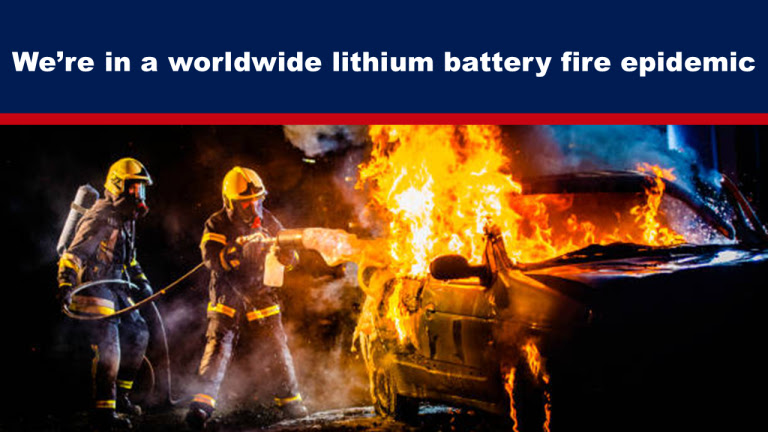
We’re in a worldwide lithium battery fire epidemic
“This is a worldwide epidemic,” Goreham told Sky News Australia. “It’s a lithium fire epidemic.”
Last year, Goreham wrote an article which was published by The Wall Street Journal as an opinion piece. Titled ‘If Green Energy Is the Future, Bring a Fire Extinguisher’, the article describes how instead of making the world safer, lithium batteries keep bursting into flames.
In his article, Gorham explained that the increasing adoption of “green” energy has led to a rise in lithium battery fires, which are breaking out in various locations, including highways, factories, home garages and storage rooms.
The high energy density of lithium batteries makes them prone to catching fire and burning with high heat, and in some cases, even exploding, which is why airlines prohibit them in checked baggage.
A battery factory fire in Hwaseong, South Korea, last year killed 22 workers, with experts estimating that most were killed by toxic gases emitted by the burning batteries.
Scotland experienced two major fires in battery recycling centres last year, one in Kilwinning and the other near Glasgow. The Kilwinning fire burned for several days with the Scottish Fire and Rescue Service urging nearby residents to remain indoors with windows closed due to the hazardous conditions. With the Glasgow fire, witnesses reported explosions, noises like gunshots, “steel flying everywhere” and a huge plume of black smoke. Ten fire trucks were needed and the blaze lasted four days.
E-bike battery fires have become a serious problem in New York City and are the leading cause of fire, causing 270 blazes last year and killing 18 people, with similar issues reported in Australia, Canada and other nations.
The introduction of electric cars has led to a massive increase in battery size and potential destructiveness, with a recent Tesla semi-truck crash in California requiring 50,000 gallons of water to extinguish the flames.
Automakers have recalled millions of electric vehicles (“EVs”) due to battery-fire problems, with some EVs prone to self-ignition banned from parking lots in China, South Korea and the US....<<<Read More>>>...
Monday, 21 October 2024
“Environmentally conscious” electric cars found to produce a BIGGER carbon footprint than gas guzzlers
Researchers at the University of Turku in Finland found that the average EV owner churns out half a ton more of carbon dioxide (CO2) annually, with owners of the sportiest EV models producing almost two tons more. Someone who owns an ICE vehicle, i.e. running on diesel or gasoline, only emits 8.05 tons of CO2 or equivalent greenhouse gases per year. In contrast, the average EV driver churns out 8.66 tons of emissions annually.
The study authors also made a distinction between two types of EV owners – those focused on performance (PF) and those focused on economy and reliability (EF). The PF group generates an average of 10.25 tons of CO2 every year, almost double the 5.75 tons produced by those who don't own a vehicle. The EF group, meanwhile, generates 7.59 tons of CO2 annually.
According to the study authors, the glamorous and high-living lifestyles of EV owners are to blame for this. They noted that income is one of the strongest predictors of carbon footprint, writing: "Since EV households tend to have a high income, their total carbon footprint is also above average."
Higher income typically leads to larger homes, more frequent travel and greater consumption – factors that significantly increase a person’s overall contribution to climate change. Nearly a quarter of all EV-owning households in the study had a monthly income of more than £6,250 ($8,201), while the average household income in the U.K. is just £2,875 ($3,772)...<<<Read More>>>...
Wednesday, 2 October 2024
Teslas are spontaneously combusting in Hurricane Helene's wake
Over the weekend, Hurricane Helene ravaged the southeastern U.S., flooding areas in six states and killing almost 100 people. The flooding also brought saltwater into contact with electric vehicles — specifically Teslas — causing them to catch fire.
News reports from Florida show multiple Teslas that caught on fire when parked in garages or near beaches.
On Saturday , the Pinellas County government in Florida tweeted footage of a Tesla bursting into flames inside a garage alongside a request that county residents tell officials if they left an electric vehicle after evacuating. In the video, the garage fills with smoke as the car burns.
"If you evacuated and left an electric vehicle or golf cart in your garage or under a building and you are not able to get to it or move it, we want you to let us know,"...<<<Read More>>>..
Saturday, 13 July 2024
EV boosters cannot do math
Each Tesla uses between 0.24 to 0.30 kWh per mile, or about 4,500 kWh over a year for 15,000 miles of driving. Other electric vehicles use more or less, but within a similar range. At 0.30 kWh per mile, that’s 90 kWh for 300 miles of driving for the typical week.
The average American household without an in-home EV charging station consumes about 30 kWh per day, or about 10,720 kWh over a year’s time. With just one electric vehicle being charged at home, that total increases to about 15,220 kWh. For two-EV households, that total runs up to nearly 20,000 kWh per year (assuming both drivers commute to work). That’s nearly double current electricity usage for such families.
Without an EV in the garage, air conditioning uses nearly a fifth of household electricity, followed by space heating and water heating (a combined 25%). But adding just one home-charged EV changes that calculus dramatically. The EV takes up about 30% ot the much higher total electricity use, dropping the share for all other uses significantly.
Two home-charged EVs would eat up nearly half the household’s total electricity usage – and require thousands of dollars to upgrade the house’s electric panel. Today’s 50-kva transformers, which cost about $8,000 each, can power about 60 homes; that number drops closer to 40 if each of those homes houses one electric vehicle, closer to 30 with two EVs using home chargers.
For a city with 120,000 homes, which today may require about 2,000 transformers, the addition of 120,000 home-charged electric vehicles means adding 1,000 transformers, about $8 million. But that’s just the tip of the iceberg, because distributing 50 to 100% more household electricity requires generating 50 to 100% more electricity.
All this costs money that most Americans today do not have, especially at the generation end. Especially with the push to eliminate electric generation from coal and natural gas and even nuclear energy. It also requires massive construction of electric infrastructure, from transmission lines to transformers to in-home charging stations accompanied by larger electric fuse boxes...<<<Read More>>>....
Sunday, 10 March 2024
Electric cars release more toxic emissions than petrol-powered vehicles and are worse for the environment
The study, which was published in 2022 but has begun circulating again after being cited in a WSJ op-ed, found that brakes and tires release 1,850 times more particulate matter compared to modern exhaust pipes which have filters that reduce emissions.
It found that EVs are 30 percent heavier on average than petrol-powered vehicles, which causes the brakes and tire treads to wear out faster than standard cars and releases tiny, often toxic particles into the atmosphere.
Hesham Rakha, a professor at Virginia Tech told Dailymail.com that the study is only 'partially correct' because even though EVs are heavier, their tires will emit more microplastics into the air, but this could also be true for sedans versus SUVs.
Rakha said it is very challenging to determine the difference between the amount of microplastics emitted from EV tire treads and petrol-powered vehicles because you have to separate the microplastics that are already in the air from other sources with what's coming off the tires.
Rakha and his team at Virginia Tech are in the process of conducting field tests to determine how much microplastics are emitting from EV and petrol cars by using traffic simulators that will mimic an urban setting.
He added that he doesn't expect there to be a major difference between the EV and petrol-powered vehicles, saying that they haven't measured it yet, but expect the difference to be about 20 percent.
This doesn't mean that people should gravitate away from electric cars because they 'are more efficient depending zero emission,' Rakha said, but added the caveat that 'it also generates a lot of CO2 when charging your vehicle.'
EV batteries weigh about 453kg, and can result in tire emissions that are nearly 400 times more than exhaust pipe emissions....<<<Read More>>>...
Saturday, 30 December 2023
Tory MP says U.K. government must acknowledge potential FIRE RISKS stemming from electric vehicles and lithium batteries
Blackman, the chair of the All Party Parliamentary Fire Safety and Rescue Group, warned that there is a huge fire safety risk to consider when discussing the planned garage. He added that if there is a problem with the wrong position, there's a chance that a block of flats could collapse.
Lithium is one of those chemicals that burns at a very high temperature. Trying to put out a lithium fire with water can be dangerous because it is very high risk.
Property developers Ballymore has drafted plans to "carefully rejuvenate" the center of Edgware, a north London suburb, with a new cinema, library, shops and restaurants, along with 3,365 new homes in 25 tower blocks.
However, the most controversial aspect of the proposal is the plan to build a "transport hub," which includes a bus station, with buses being stored and charged overnight at the basement level. The hub will be located under one of the residential towers....<<<Read More>>>...