Search A Light In The Darkness

Showing posts with label A.I Recognition Machines. Show all posts

Friday, 17 January 2025

AI Facial Recognition Software Resulting In False Arrests

 “Orwell is here, and he’s living large, man!”

Police nationwide are misusing facial recognition software, relying on it to arrest suspects without additional evidence, according to a new investigation by the Washington Post.

Most departments aren’t required to disclose or document its use. Among 23 departments with available records, 15 across 12 states arrested suspects based solely on AI matches, often violating internal policies requiring corroboration.

One report called an unverified AI match a “100% match,” while another claimed the technology “unquestionably” identified a suspect. At least eight people have been wrongfully arrested in the U.S. due to AI matches, two of which were previously unreported.

All cases were dismissed, but basic police work—such as checking alibis or comparing physical evidence—could have prevented these arrests. The true scale of AI-fueled false arrests remains unknown, as most departments lack disclosure requirements and rarely reveal AI use.

The Post identified 75 departments using facial recognition, with records from 40 showing arrests tied to AI matches. Of these, 23 provided sufficient detail, revealing that nearly two-thirds made arrests without corroborating evidence. Departments often refused to discuss their practices or claimed officers relied on visual judgment to confirm matches.

In Florence, Kentucky, police used uncorroborated AI matches in at least four cases, with mixed outcomes. Local prosecutor Louis Kelly defended officers’ judgment in identifying suspects, including those flagged by AI.

For its report, the Washington Post reviewed facial recognition use by 75 police departments, with detailed records from 23. It found 15 departments, including Austin, Detroit, and Miami, made arrests based solely on AI matches without independent evidence.

Some lacked records or transparency, while others relied on questionable practices like showing AI-identified photos to witnesses. Interviews clarified some cases, but reliance on uncorroborated AI remains widespread....<<<Read More>>>....

Tuesday, 23 July 2024

Facial recognition and AI monitoring deployed in India’s largest railway network

 India’s rail networks are adding AI and facial recognition systems to their stations, part of a growing biometrics and surveillance market experts predict will be worth more than US$15 billion within the next five years.

A release from IDIS Global says the South Korean video surveillance manufacturer is providing Indian Railways, Asia’s largest rail network, with a 4K camera system equipped with integrated AI video analytics and facial recognition technology from Herta Security. The first phase of a major technology update for the rail system saw cameras placed across hundreds of platforms in 230 high-traffic stations across the country’s eastern region in May 2024.

Herta Security’s facial recognition algorithms provide real-time identification and alerts to persons-of-interest. IDIS’s configurable deep learning analytics system analyzes motion, loitering, abandoned object detection and line crossing. With a monitoring center installed at every fifth station along the network, railway authorities have a connected ecosystem of command and control hubs through which to monitor, analyze data and respond to crisis events.

Moreover, the system’s video management platform offers mobile surveillance through the IDIS Mobile Plus app, wherein image and video captured from smartphones can be fed into the system.

“Indian Railways wanted the most flexible, robust, future-proof video surveillance solution to provide a secure foundation for growth and development plans,” says Rahat Jain, managing director of IDIS Securitatem Solutiones Pvt Ltd, a joint venture between IDIS and Indian systems integrator M2M Cybernetics. “With IDIS video, the Railway Protection Force now have full confidence that they are operating 230 of the safest and most secure stations, resulting in two more regions being identified for upgrade.”

Indian Railways 14,000 trains carry an estimated 9.5 million passengers daily. The network expects to handle up 40 percent of global rail activity by 2050.

Railway lines in Delhi are also acting on AI. The Delhi Metro Rail Corporation (DMRC) has plans to deploy AI as part of an initiative to improve efficiency and crowd management, according to a report in the Economic Times. DMCR Managing Director Vikas Kumar says AI for driverless trains is part of the plan, along with amped up facial recognition and CCTV camera surveillance....<<<Read More>>>...

Friday, 8 December 2023

Amazon’s new generative AI assistant “Q” has “severe hallucinations” and leaks confidential data

Amazon’s fledgling generative AI assistant, Q, has been struggling with factual inaccuracies and privacy issues, according to leaked internal communications.

The chatbot was recently announced by Amazon’s cloud computing division and will be aimed at businesses. A company blog post says it was built to help employees write emails, troubleshoot, code, research and summarize reports and will provide users with helpful answers that relate only to the content that “each user is permitted to access.”

It was promoted as a safer and more secure offering than ChatGPT. However, leaked documents show that it is not performing up to standards, experiencing “severe hallucinations” and leaking confidential data.

According to Platformer, who obtained the leaked documents, one incident was flagged as “sev 2.” This designation is reserved for events deemed serious enough to page Amazon engineers overnight and have them work on the weekend to correct them. The publication revealed that the tool leaked unreleased features and shared the locations of Amazon Web Services data centers.

One employee wrote in the company’s Slack channel that Q could provide advice that is so bad that it could “potentially induce cardiac incidents in Legal.”

An internal document referring to the wrong answers and hallucinations of the AI assistant noted: “Amazon Q can hallucinate and return harmful or inappropriate responses. For example, Amazon Q might return out of date security information that could put customer accounts at risk.”

These are very worrying problems for a chatbot that the company is gearing toward businesses who will likely have data protection and compliance concerns. It also doesn’t bode well for the company in its quest to prove that it is not falling behind its competitors in the AI sphere, like OpenAI and Microsoft....<<<Read More>>>...

Saturday, 2 October 2021

Test Your Ability to Discover Truth

[Collective Evolution]: A psychological exercise called the Ideological Turing test, helps individuals explore their ability to critically analyze ideas, topics and beliefs.

The conclusion is if you cannot explain someone else’s perspective about something, there’s a decent chance you are either wrong or have not taken the time to understand what the topic truly entails.

Many of us exist in this category, which is partly why our society is so divided today.

Historically a Turing test is used in AI development when developers are testing whether or not their AI model can think like a human. The test is named after Alan Turing, a computer scientist, cryptanalyst, mathematician and theoretical biologist.

“Turing proposed that a human evaluator would judge natural language conversations between a human and a machine designed to generate human-like responses. The evaluator would be aware that one of the two partners in conversation is a machine, and all participants would be separated from one another. The conversation would be limited to a text-only channel such as a computer keyboard and screen so the result would not depend on the machine’s ability to render words as speech. If the evaluator cannot reliably tell the machine from the human, the machine is said to have passed the test.” – Wikipedia

Basically if a human can’t tell the difference between responses from a computer or a human, the computer has passed.

Now, the Ideological Turing Test is similar but slightly different. This time, instead of a computer passing off as a human, you have to be able to explain an opposing position of an argument as well as your opponents would. I.e. as if you believe it yourself. If you can convincingly do so, you have passed the test.

This would essentially mean you know how to listen to others and truly understand other people’s perspective around an argument.

Let’s take COVID vaccination, a hot topic that has people arguing constantly. Do vaccinated or unvaccinated people cause variants to emerge? Some will say it’s the vaccinated, others will say it’s the unvaccinated, but can you explain the perspective of both sides?

As a journalist, I can tell you that there is a scientific pathway for either to be true. But many who believe the vaccine to be highly dangerous will bias towards the vaccine being the cause of all variants. Where as, those who believe the unvaccinated are creating variants, will often simply think the unvaccinated are stupid and a problem to society, yet they are not aware that they themselves could be a source of an emerging variant....<<<Read More>>>...

Tuesday, 4 February 2020

Revealed: Big Brother facial recognition cameras are watching you more than ever - being used by ten police forces, councils and hundreds of shops across Britain

[David Icke]: The secret expansion of controversial facial recognition technology has been laid bare after an investigation by The Mail on Sunday discovered it is now being used by ten police forces, councils and hundreds of shops.

Civil liberties groups are increasingly worried by the spread of the 'Big Brother' cameras which record a person's face as they walk along a street and convert the image into an 'algorithmic pattern', or 'biometric print', which is compared to faces on a database of suspects.

If a match is found, police officers can be ordered to stop and search this person.

A secret Home Office document, seen by this newspaper, names the ten police forces in England and Wales that have trialled live facial recognition (LFR) technology and are now ready to roll out the cameras for wider use...<<<Read The Full Article Here>>>...

This uncanny AI can guess what you look like by analyzing voice recordings

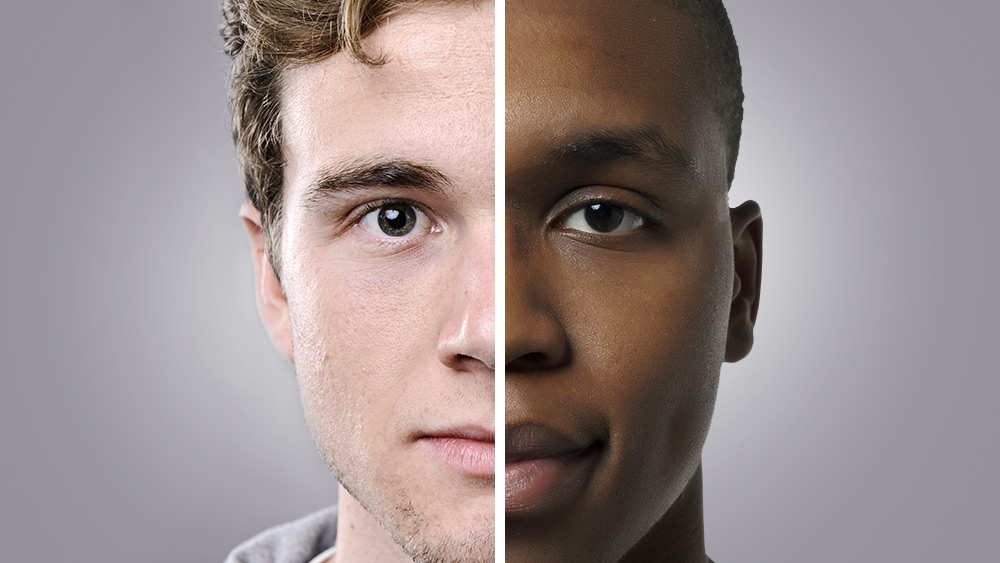
[Natural News]: Researchers from the Massachusetts Institute of Technology (MIT) are working on an AI project that can accurately map what people look like just by analyzing voice recordings from the internet. The researchers published their first paper on the project: “Speech2Face: Learning the Face behind a Voice.”

The researchers trained the AI neural networks using millions of YouTube audio clips taken from the internet. The clips included voice audio from over 100,000 individuals. The AI was able to make clever distinctions in voice tone and inflection and could accurately predict the age, gender and ethnicity of the individuals. Most shocking: The AI attempted to recreate the faces of the people based on the sound of their voice alone. The computer simulation was able to determine key features on people’s faces and then generate lookalike photos of the people — all based on random audio clips.

The researchers did not intervene in the project. The AI grew smarter on its own. After analyzing millions of audio clips, the computer was able to recreate faces that closely resembled the original speaker in the video clip. The AI was not 100 percent accurate and failed to judge some of the ethnicities, especially when a person spoke more than one language...<<<Read The Full Article Here>>>...

Monday, 21 October 2019

How can a small patch of printed material fool A.I. surveillance?

[Natural News]: This one’s for sci-fi lovers: A team of machine learning researchers from KU Leuven in Belgium found a simple hack to trick surveillance systems into thinking that a person is invisible.

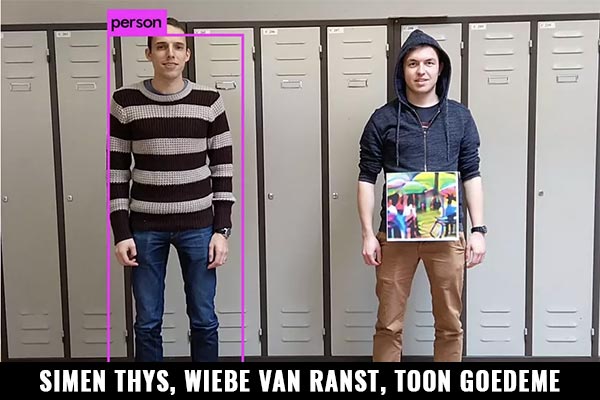
In their paper, which they presented in this year’s Conference on Computer Vision and Pattern Recognition, the team revealed how wearing a colorful printed patch no bigger than a vinyl record is enough to evade an artificial intelligence system designed to detect humans.

“We believe that, if we combine this technique with a sophisticated clothing simulation, we can design a T-shirt print that can make a person virtually invisible for automatic surveillance cameras,” the researchers wrote in their report.

The team also uploaded a video to demonstrate how the patch works. In the video, two researchers stood in front of a camera outfitted with an algorithm that identifies objects and humans in the frame. While the program marked the person without the patch, his counterpart (who was wearing the patch) wasn’t detected. As it was flipped to its blank side, the camera then detected both researchers...<<<Read The Full Article Here>>>...